Cardiac, thoracic and transplant surgery in the UAE

Excellent, 4.99 out of 5 from 117 patient reviews. Read verified reviews on Doctify.

Emergency advice

If you have chest pain now, call 998.

In an emergency call 998.

Treatment information

Total Arterial Coronary Bypass Surgery: A Durable Alternative to Multiple Coronary Stents

The short answer

Total arterial coronary bypass surgery uses only arteries — usually both internal thoracic (mammary) arteries and the radial artery — as bypass grafts. Arterial grafts stay open longer than vein grafts, and in suitable patients with complex multivessel disease this may offer more durable protection than multiple stents. It is not right for every patient; PCI remains appropriate for selected lower-complexity disease and is essential in many acute heart attacks.

Coronary revascularisation designed for long-term durability

Total arterial CABG versus multivessel PCI

Total arterial CABG

Creates alternative blood supply pathways beyond diseased coronary segments.

Multivessel PCI

Treats individual coronary obstructions within the existing diseased arterial circulation.

Complete revascularisation

Treatment of all appropriate coronary territories

Multiple arterial grafting

Durable biological conduits

Sternum preservation

Minimally invasive surgical access where appropriate

Long-term cardiac protection

Reduced recurrent ischaemic events and repeat interventions

Schematic of total arterial grafting: left internal thoracic artery to LAD, right internal thoracic artery to circumflex marginal, radial artery from the aorta to the right coronary arteryLITA→ LADRITA→ circumflex marginalRadial artery→ RCA / PDAAorta

Bilateral internal thoracic and radial artery grafting

A typical total arterial configuration: the left internal thoracic artery (LITA) to the left anterior descending artery, the right internal thoracic artery (RITA) to the circumflex territory, and a radial artery graft to the right coronary territory. The exact configuration is tailored to each patient's anatomy.

Simplified schematic, not to scale.

Therapeutic characteristicMultiple arterial CABGMultivessel PCI
Revascularisation mechanismAlternative biological blood supplyTreatment of individual stenoses
Diffuse coronary diseaseParticularly advantageousCan require extensive stent implantation
Protection against proximal disease progressionPotential protectionLimited to treated segments
Long-term conduit durabilityExcellent in suitable arterial graftsRisk of restenosis and stent failure
Repeat revascularisationGenerally lowerGenerally higher
Diabetes with multivessel diseaseGuideline-preferred in suitable patientsLess favourable long-term outcomes

Observational evidence — propensity-matched registry, not a randomised trial

CABG versus multivessel PCI: six-year clinical outcomes

A 2026 Medicare study of 118,921 patients undergoing multivessel coronary revascularisation between 2018 and 2023 compared 9,206 propensity-matched patients in each group. Adjusted hazard ratios, PCI reference = 1.00.

All-cause mortality

CABG 0.44
PCI 1.00

56% lower adjusted hazard with CABG

Myocardial infarction

CABG 0.40
PCI 1.00

60% lower adjusted hazard with CABG

Repeat coronary revascularisation

CABG 0.10
PCI 1.00

90% lower adjusted hazard with CABG

Freedom from death, MI or repeat revascularisation

CABG 89.2% · PCI 71.1%

18.1 percentage-point absolute difference

62% lower

hazard of the combined endpoint with CABG

HR 0.38; 95% CI 0.35–0.41; P < 0.001

These results compare CABG in general with multivessel stenting; they are not specific to total arterial grafting. Observational data cannot fully exclude selection bias. Multiple arterial grafting aims to maximise the durability of surgical revascularisation, and robotic-assisted and sternum-sparing techniques may offer additional recovery advantages in selected patients.

Source: DeFazio D, et al. Coronary Artery Bypass Grafting versus Percutaneous Coronary Intervention for Stable Multivessel Coronary Disease in the Current Era. Ann Thorac Surg. 2026;122(6):1539–1546. doi:10.1016/j.athoracsur.2026.06.059 · Full text (PMC)

Observational evidence — not a randomised trial

Risk of adverse outcomes relative to multiple arterial CABG
Multiple arterial CABG (reference 1.00) Drug-eluting stents

Late mortality

CABG 1.00
Stents 1.53

Repeat coronary revascularisation

CABG 1.00
Stents 3.51

Adjusted hazard ratios from a propensity-adjusted observational study of 6,126 patients with multivessel disease (mean follow-up 4.9 years): 53% higher hazard of late death (P = 0.02) and 3.51 times the hazard of repeat revascularisation (P < 0.0001) after PCI. Observational comparisons cannot fully exclude selection bias. These are published study results, not individual surgeon outcomes.

Source: Raja SG, Benedetto U, Ilsley CD, et al. Multiple arterial grafting confers survival advantage compared to percutaneous intervention with drug-eluting stents in multivessel coronary artery disease: a propensity score adjusted analysis. Int J Cardiol. 2015;189:153–158. doi:10.1016/j.ijcard.2015.04.059 · PubMed

How strong is the evidence?

  • Direct randomised evidence: trials comparing CABG (mostly one arterial graft plus veins) with stents — SYNTAX, FREEDOM, FAME 3.
  • Randomised evidence on conduits: radial artery versus saphenous vein trials (pooled RADIAL analysis).
  • Observational evidence: registry comparisons of multiple arterial grafting with stents, adjusted for patient differences.
  • Indirect comparisons: no large trial has directly randomised total arterial CABG against multivessel stenting.

Key terms explained

Total arterial coronary bypass surgery Dubai, multiple arterial grafting, arterial bypass surgery versus stents, bilateral internal mammary artery grafting, radial artery coronary bypass graft, best long-term treatment for triple-vessel disease, long-term survival after arterial bypass surgery, robotic arterial coronary bypass surgery, sternum-sparing total arterial revascularisation

About total arterial coronary bypass surgery

Conventional CABG usually combines one internal thoracic artery with saphenous vein grafts, which are more prone to late failure. Multiple arterial grafting replaces some or all vein grafts with the right internal thoracic artery and/or the radial artery.

Robotic harvesting of the internal thoracic arteries and sternum-sparing TCRAT access can, in selected patients, combine arterial grafting with a smaller incision. Suitability and availability require individual clinical and hospital assessment.

When is treatment recommended?

  • Complex triple-vessel coronary artery disease
  • Diabetes with multivessel disease
  • Complex proximal LAD or left main disease
  • Diffuse disease or recurrent narrowing after previous stents
  • Younger patients with good life expectancy

Benefits, limitations and complications

Limitations

Bilateral internal thoracic artery harvesting may increase the risk of sternal wound problems, particularly in obese patients with diabetes. The radial artery is avoided when hand circulation is inadequate. Much of the evidence for multiple arterial grafting is observational, and the randomised ART trial did not show a ten-year survival benefit in its intention-to-treat analysis.

Frequently asked questions

References

  1. Gaudino M et al. Radial-Artery or Saphenous-Vein Grafts in Coronary-Artery Bypass Surgery (RADIAL). New England Journal of Medicine. 2018
  2. Taggart DP et al. Bilateral versus Single Internal-Thoracic-Artery Grafts at 10 Years (ART). New England Journal of Medicine. 2019
  3. Thuijs DJFM et al. SYNTAX Extended Survival study. Lancet. 2019
  4. Vrints C et al. 2024 ESC Guidelines for the management of chronic coronary syndromes. European Heart Journal. 2024
All coronary surgery topics

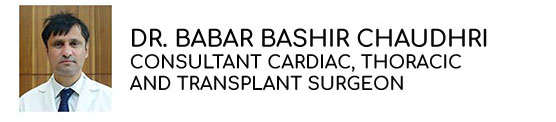
Your surgeon: Dr Babar Bashir Chaudhri

Consultant Cardiac, Thoracic and Transplant Surgeon, King’s College Hospital London, Dubai

BA, MB, BChir, MA (Cantab), MD (London), FRCS Eng, FRCP Edin, FRCS CTh, FACS, CCT UK Cardiothoracic Surgery

Trained in London and Scotland, in clinical practice since 1992, with experience across coronary, valve, aortic, heart failure and transplant surgery.

Full profile

Non-emergency opinions and referrals

For survivors, residual aortic disease or a second opinion. Suspected acute emergencies must call 998 and use hospital emergency pathways.

Appointments & referrals

Discuss this treatment with the practice

Contact the practice to arrange a consultation, request a second opinion or ask about a referral.